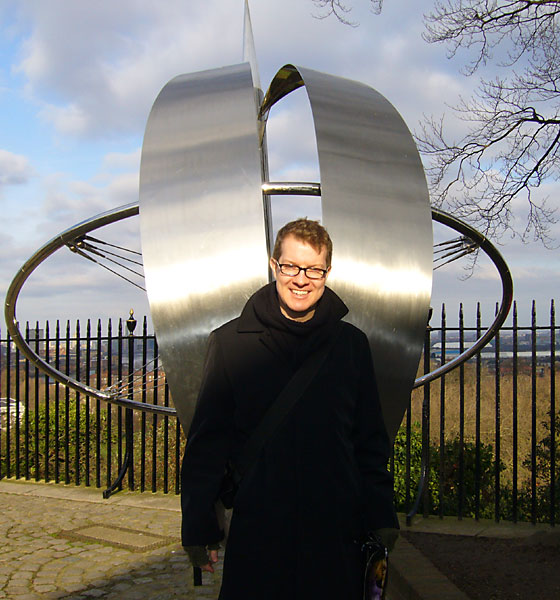
While in London, I finished the wonderful book by Dava Sobel called Longitude. For hundreds of years, sailors roaming the seas could tell their latitude by the angel of the sun, but the longitude was a mystery. The cost literally thousands of lives and more important to the shareholdes, lots and lots of money. Astronomers like Haley were not giving stipends to gaze at the stars for their own curiousity. They we trying to “discover the latitude” by mapping the stars. Back then, “discover the latitude” was a common phrase with a meaning similar to today’s “find a cure for cancer”–an impossible but wonderful goal. I always thought asrtonomy was just for shits and giggles, but it was 100% applied and for the bucks, which makes me respect those cats more.
“Longitude” tells the story of John Harrison who eschewed the stars and spent fifty years building a watch accurate enough (to the exact second, day in, day out) to be used to determine the longitude. For such a watch to work, there has to be a “homebase” of time and longitude. The thinkers of that day established it at the observatory in Greenwhich, home of the Astronomer Royale (without cheese).The book is a short and clever read and an ideal choice for the flight over.
Many of the artifacts associated with Harrison, along with lots more High School Science (which is one of my loves, geek that I am), are at the Observatory and Maritime Museum at Greenwhich, which is just short ferry ride from central London. While staring at a replica of H1, Harrison’s first maritime clock prototype, a museum guide delivered near and then opened up when I gave a nod of interest. To my absolute delight he described how every piece front to back contributed to the reliability of the clock..the grasshopper escapement, the gridiron pendulum that uses different metals to counteract the affects of tempature, and a unique frictionless system of levers and knobs. It made me want to build a clock. It made Ildi want to get lunch.

THE Prime Meridian. Accept no other meridians.

A red ball rises up on a mast above the observatory and falls at exactly 1PM everyday. While the ships of England would travel down the Thames to conquer the world, they would set their maritime clocks by the ball, hoping the time would eventually guide them home.

The observatory gives a fine view of the Maritime Museum and the London skyline. Those tall buildings are seven miles down the Thames from central London. I’m not sure what they are or what that hood is called.

These women also came to see the me and the meridian.

I love authentic English food.

This girl is too pretty to put up with Science Day.
I only got one decent picture from the ferry ride,because it was overcast and misty in London, which is unusual. Normally it is overcast, misty, and cold. Despite this, the ferry was one of the best parts of the trip. The river is the heart of the city and riding along it gives a view of many of the main attractions like Tower Bridge, the Eye, and the rebuilt Globe Theatre.

The Bard’s home through a rain spattered ferry window.
“I am constant as the northern star,
Of whose true-fix’d and resting quality
There is no fellow in the firmament.”
–From Julius Caesar (III, i, 60 – 62)
I bet Caesar would have had a website called JuliusTCaesar.com. He gets the knife shortly after this line.
Related Links:
– Royal Observatory, Greenwich
– National Maritime Museum
– Globe Theatre